Backcountry Skiing, Snowboarding (spilt-boarding) Q&A Series, part 1

Alyssa Olenberg-Meltzer

Photo Credit: www.jshawphoto.com Jonathan Shaw Photography

Part 1 – Backcountry Skiing, Snowboarding (spilt-boarding) Q&A Series

The boom in backcountry skiing, snowboarding and other snow-sports was brought on by the COVID-19 pandemic as ski resorts started closing down like falling dominoes starting in March of 2020 as state and local counties mandated ‘stay at home’ (SIP) orders as coronavirus outbreaks spiked.

Winter season 2020/21 will likely see similar trends especially pronounced if resorts are unable to implement effective protocols of limiting on-site visitors’ capacity, and social distancing especially indoors in common areas which will result in COVID infection outbreaks resulting in resorts’ closures.

Of particular concern is that finally CDC acknowledges that the coronavirus infection transmission is airborne by aerosols which means it is highly contagious. This fact does not bode well so we’ll see how this flu season and winter months play out.

Back to our topic, our backcountry Q&A feature looks at backcountry from a range of diverse perspectives, from an amateur to expert backcountry skier, from a ski shop small business retailer to backcountry touring guide, these Q&A series provide some key insights and also we’ll list resources to consider for avalanche safety training that is critical to stay safe in the backcountry. Most importantly, we list key resources to connect you with folks who share a passion and love for the backcountry.

Part 1 Q&A interview with Alyssa Olenberg-Meltzer who got into backcountry skiing and loves it from the start; she has four winters of experience..

With the impact of resort closures due to the COVID pandemic from mid-March of this year, can you describe from your observations if there’s an increase in demand for backcountry skiing/boarding/snow-sports?

Anecdotally, I can say that I have had a few friends reach out to me expressing interest….these are all folks that have been meaning to try backcountry skiing/splitboarding for at least a couple years but haven’t gotten around to it because it seemed too expensive and like a huge time commitment. We’ve had at least a couple posts and many comments from new folks on the group’s facebook page from folks interested in getting started. Personally, I’ve talked to more current backcountry skiers who are worried about new users flooding the backcountry than I’ve talked to people who plan to go backcountry skiing for the first time.

Do you know if there are backcountry snow sports folks from around the world visiting Tahoe/Sierra Nevada? Would BC visitors be able to connect with your FB group (see link below in resources) BC folks to freeski/split-boarding with when they join your group?

Yes, anyone can join and we love discussion. Lots of members (myself included) have found partners through posting on the group (see link below in resources), and at the very least posting is guaranteed to get you tons of advice from enthusiastic members. While everyone is nervous that an influx of new backcountry users may be a safety concern, I definitely believe that the people who are willing to spend time researching before they go out and asking questions of experienced backcountry users will be better equipped to make better-informed decisions, and I know that all of the moderators are committed to being welcoming and not acting like pompous gatekeepers.

That said, try to get some training before you go out. I wouldn’t feel super comfortable going out with someone who hasn’t had a good amount of practice with their beacon, shovel, and probe; an avalanche rescue course or AVY 1 is a good credential to put partners at ease.

How does a newbie get started in BC in three essential steps? What are just the bare essential set-up for BC skiing or split-boarding?

Step 1/pre-requisite: be comfortable skiing at least moderate un-groomed slopes in all snow conditions.

1) Get comfortable with backcountry equipment. I recommend both practicing what you can at home to make everything less fiddly (step into bindings, put on skins, transition, etc), and spending some quality time skinning without skiing. Cross country ski trails and flat forest service roads are great for skinning practice!

2) Learn to read terrain both from maps before you go out and in the field. I recommend spending lots of time staring at CalTopo maps with the slope angle shading overlay turned on for areas you know well- your usual ski runs are perfect, places you hike frequently, etc. You want to be able to have a mental image of what enjoyable (to you) skiing looks like on a map, so you can identify good potential routes. It’s also critical for being able to identify terrain traps to avoid and safe ascent routes.

3) Take an Avalanche AVY Level 1 course. It’ll help you understand avalanche terrain, improve your decision making process in the backcountry, give you necessary hand-on practice with beacons and probes and digging efficiently, and you may meet some great partners.

Bare minimum setup:

– skis/splitboard with AT, telemark or splitboard bindings
– boots for said bindings
– skins
– poles
– beacon, shovel, probe
– a comfortable backpack, preferably with a solid separate compartment for your shovel and probe that you can very quickly access
– warm, breathable and sweat-wicking layers…here in California much of my backcountry skiing is in thin soft-shell pants and relatively light base layers, but obviously having warm layers, windproof and waterproof layers is essential for safety and comfort. Packable is usually key too.

Your recommended gear and manufacturers with a success track record of building solid skis and or boards?

I care a lot more about my boots than my skis to be honest, but since you’re asking….Coalition is a Tahoe company that’s pushing the inclusion and equity that I want to see more of in the outdoor industry and makes super fun skis to boot! Also in the area, Moment makes some really killer skis too.

Can you recommend avalanche training outfits and mountain guides locally/in Tahoe/in Reno?

As part of the Mountain Festival, I took a course through Alpenglow Expeditions with Will Sperry and Ali Agee that really built my knowledge and confidence with reading avalanche conditions and terrain! I also can attest to Richard Bothwell (owner of Outdoor Adventure Club) as being a really thoughtful guide who will make you think critically about your risk taking and has a great attitude.

What is the takeaway message you’d like to get out to newbies about the joy of snow sports and the importance of Avy training, on-going BC education and connecting with mentors, ski buddies for safety?

Don’t be scared to reach out and ask questions. The folks worth going out into the mountains with will be happy to share their enthusiasm with you. Try to gain as much competence as you can on your own before going out by ideally taking Avy 1, or at least learning how to read an avalanche forecast, understanding the nine avalanche problems, and trying to solidify your terrain reading skills, and practicing with a beacon, shovel, and probe; then be ready to ask questions and learn.

Anything else you would like to add?

A lot of people assume that backcountry skiers start exploring the backcountry because they’re bored in resorts and want radder lines, but my experience was the opposite. I got interested in skiing because I love spending time in the mountains in the summer and wanted to get to explore the forests and alpine I loved in the winter. I tried cross country skiing once, but it seemed like it would be difficult to access the places I really wanted to go without beefier equipment. I started skiing resorts in January 2016 with the goal of gaining competence for backcountry skiing (but quickly fell in love with skiing because it is insanely fun, who knew?).

I went on my first tour in May 2016 and took Avy 1 the next winter, and since then I’ve become more and more obsessed. I’m still not, and probably will never be, a hotshot skier, but time in the backcountry has definitely helped my confidence in skiing all sorts of different snow and terrain, and the more competent I get, the more fun I have. It’s the hobby that brings me the most joy, I think because I get to have the unparalleled peace that comes with being in the mountains in the snow and the rush of racing down in the same day.

To be honest, COVID precautions are going to make it harder to get comfortable backcountry skiing. I’ve progressed and become more confident thanks to mentorship and some social situations…backcountry cabins, ski races, and classes. Try your hardest to find solid mentors that you feel comfortable going out with. And I can’t overstate the importance of this…be sure you understand what avalanche terrain is, what the nine types of avalanche problems are, and how to read an avalanche forecast before you go out. Lastly, don’t be falsely reassured by having a beacon, shovel, and probe; be sure you’re completely proficient in their use.” – Alyssa Olenberg-Meltzer, SF Bay Area resident and a member of the San Francisco Backcountry Skiers Facebook Group.

human-powered-backcountry

backcountry-skiing

edward-caldwell-photography

Photo Credits: Edward Caldwell Photography https://edwardcaldwell.com

Part 2 

Read our Q&A with Greg of California Ski Company, a retail store specializing in ski, backcountry, and touring gear and service based in Berkeley, CA.

Part 3 

Interview with Robert Shattuck, founder of San Francisco Backcountry Skiers (SFBS) Community on Facebook Groups.

 Part 4

Interview with Richard Bothwell, Backcountry Touring Guide and Director of the Outdoor Adventure Club

Part 5 

Interview with Carl Hlavenka, ski patroller with Tahoe Backcountry Ski Patrol and California Winter Search and Rescue Team North

Part 6 

Interview with Shane Robinson Owner & Lead Guide at Graybird Guiding based out of Baker Mt, WA

Part 7 

Interview with Mathias Bjoern, Founder of 48 FreeRiders, a backcountry ski, board community based out of Denmark

Backcountry Skiing, Snow-Sports Resources

✔ San Francisco Backcountry Skiers Facebook Group: ‘San Francisco Backcountry Skiers (and Riders) is a resource and inspiration for people in the San Francisco area (and beyond) who are interested in backcountry skiing and riding. SFBS welcomes both experienced and aspiring backcountry skiers and riders.’ Membership type: free, public group. 3.3k members. Visit their FB group page.

✔ SnowPals.org is a non-traditional snow-sports club for busy Bay Area professionals. Join SF Bay Area professionals to expand your circle of ski and ride buddies (resort based and backcountry), btw, that’s how we came up with our name: Snow (Snow-Sports) + Pals. Membership type: one-time paid membership fee of $20; join SnowPals. Read members’ intros to get an idea who joins. Founded in 1999 by a small group of friends; we are now 8,249 members and growing. Celebrating our 21st year of connecting folks to expand their circle of snow sports activity partners.

Sierra Avalanche Center’s education resources where you can get the backcountry safety education and hands on training

Lake Tahoe Backcountry Ski Topographic Maps and Guidebook

California Ski Company in Berkeley is one of the top ski shop retailer for ski gear for sale and rentals, plus boot fitting and equipment service. Cal Ski Co is a ‘specialty ski shop focused on ski equipment sale and rental since 1989. They sell and rent equipment for both Resort and Backcountry Ski Touring. Their team of expert ski boot fitters are the best in the business. They repair and tune about anything that slides on snow. Looking for a job? Cal Ski Co is currently hiring as of October 29, 2020. Full-time and part-time employment available: job openings, ski tech and boot-fitter. Experience is desirable but not necessary. The only criteria is that you are a skier. Interested or know of someone who is? Email resumes to .’

✔ Backcountry and Outback Adventures for Telemark and Randonee Ski Rentals, Fremont, CA and Larkspur, CA – Outback Adventures is a comprehensive outdoor adventure guide service, rental shop, and paddlesports and nordic ski specialty retailer located in the San Francisco Bay Area.

Sequoia National Park Lodging WUKSACHI LODGE

Located in the Giant Forest area of Sequoia National Park, Wuksachi Lodge is a modern lodge with 102 guestrooms. It offers a cocktail lounge, a full service restaurant and both a retail and ski shop. At an elevation of 7,050 ft. (1,980 m), Wuksachi Lodge is only 4 miles away from the Giant Forest Museum.
Delaware North Parks & Resorts offers multiple services like overnight accommodations, retail, food and beverage, etc. at Kings Canyon National Park in the area of Grant Grove and Cedar Grove. Limited Internet is available in some areas of the main lodge. Wuksachi Lodge is open throughout all the seasons.

GRANT GROVE CABINS

At an elevation of 6,500 ft (1,980 m), the Grant Grove Cabins is located in the Grant Grove area of Kings Canyon National Park. It offers 6 types of cabins; some are even opened all year. Main attractions like a sequoia grove, gifts shop, markets and restaurants are half a mile (800m) away from the Grant Grove Cabins. Open: All Year (limited in the winter)

✔ PEAR LAKE WINTER HUT

Managed by the Sequoia Parks Conservancy, Pear Lake Winter Hut is a rustic hut of 10 bunk beds that opens during winter and requires reservations but only for wilderness skiers who travel to Pear Lake during the cold season. At an elevation of 9,200 ft. the hut sits high above Lodgepole. This hut includes a wood-pellet stove. To get to it, you need to go through six miles on skis or snowshoes. Reservations can be made online or by phone: 559-565-3759.

Got a key backcountry resource not listed here that you’d like to share? Contact . Advance thanks for sharing.

* Browse Tahoe area rentals and private seasonal ski leases:
?
http://www.snowpals.org/rentals/

* Browse shared ski leases: :
?
http://www.snowpals.org/leases/

* How to increase bookings for your rental, ski lease listing on Airbnb, VRBO, HomeAway, FlipKey, Craigslist:
?
http://www.snowpals.org/2020/property-owners-guide-tips-create-appealing-listing-vacation-rental-ski-lease/

♥ Share this page with friends and family via twitterfacebook.


Tahoe Ski Season Survey & Insights

list on SnowPals to get results

Looking to share a ski lease or are you a ski lease organizer? We’re trying to gauge interest, consider sharing your input with the following survey..

Like many of you, the ski/snowboard community is trying to adjust to the new normal with the COVID-19 pandemic still at the top of many of our minds. You can help us by sharing your opinion about ski lease housing options.

Please take a few minutes to help us at SnowPals understand your thoughts for the upcoming 2020/2021 Ski Season. Your opinion matters and will help ski Lease/ski club operators better adjust.

Our ski lease share housing survey concluded on 9/21/20. The following are the top level results:

    1) Did you participate in a ski lease last season for 2019/2020?

41% YES

    2) Has the Covid-19 crisis & ‘work from home’ changed your ability to ski mid-week? (Select the option the best describes your situation.)

48% Yes, it has changed, I CAN NOW ski mid week!!!

    3) What type of membership are you looking for?

66% Full time

    4) Are you planning to participate in a ski lease for the 2020/2021 season? Given providers can offer a safer alternative (with Covid-19 exposure minimization as the focus) to a traditional lease?

57% Maybe, it depends on the what the offering is

    5) If you were to join a lease this year, how would you join?

48% As an individual

    6) If ‘No’, please share with us why you have decided against participation in any ski lease for 2020/21? (Enter ‘N/A’ if you answered ‘Yes’ or ‘Maybe’ previously.)

Survey responses:

“Not sure it will work for us. open to reviewing available options, though.”

“I would be comfortable with a ski lease with MY friends, but am wary about joining with strangers due to COVID.”

“This is not the year to risk my family’s health to go boarding. We’ll be hitting the mountains, but most likely traveling up “day of.”

“Currently undecided, waiting to see how pandemic restrictions will be for the winter – if infections will or will not get out of control. It’s really a cost/risk/benefit analysis so still on the fence.”

“Uncertainty about ski resorts operating.”
Due to uncertainty around ski resort opening and constraints around leases, I will figure out after the season has started what I’ll do.
“Covid concerns”

“Limited funds/money for leisure budget this year”

“Not safe to be in a ski lease”

“For my family, it’s a lot of work to ski with a toddler, and they’re not good at social distancing or hygiene. The resort plans kinda sound like a mess, and it’s hard to plan backcountry days when only one of us can go at a time.”

“I don’t trust a group of random skiers to truly be covid safe unless it was proven”

“Covid – too much expanded risk. Last year’s lease had wonderful people – including icu nurse, home healthcare provider. May contribute financially to our ski lease group so it’s in existence a year from now.”

“Haven’t decided yet. Waiting to see if we get COVID infections under control especially during flu season/winter months.”

“I would only join with people I know and trust who agree to keeping the ski lease closed to others.”

    7) If you were to participate, which Tahoe area?

South Shore: 28% or about 1 out of 3

North Shore: 55% or about 1/2

    8) What are your concerns about joining a ski lease this season?

39% Related to the people I would be joining with (related to Covid-19 exposure)

33% Related to the possibility of limited access to the house vs. the cost to join (because of possible Covid-19 limitations)

    9) Which one of these ski lease configurations would be most interesting to you? (Given cleaning and safety options were put in place).

Smaller Bubble Lease:  Leasers in small bubbles (4 to 6 lease members). A smaller lease with NO OVERLAP between bubbles of leasers between the weekend and mid-week leasers. Possible guaranteed room for you and your partner. Example: Weekend+ Bubble A (Friday through Monday) has access the first weekend, Midweek has access for 3 days (Tuesday through Thursday), Weekend+ Bubble B has access for the next weekend, repeat.

For reference/access the survey at

https://www.surveymonkey.com/r/RRXDFTP

Advance thanks,

– Your friends at SnowPals

Survey questions created by Mike K., South Tahoe ski lease organizer.


What are on most people’s minds in regards to 20/21 ski season as winter is coming?

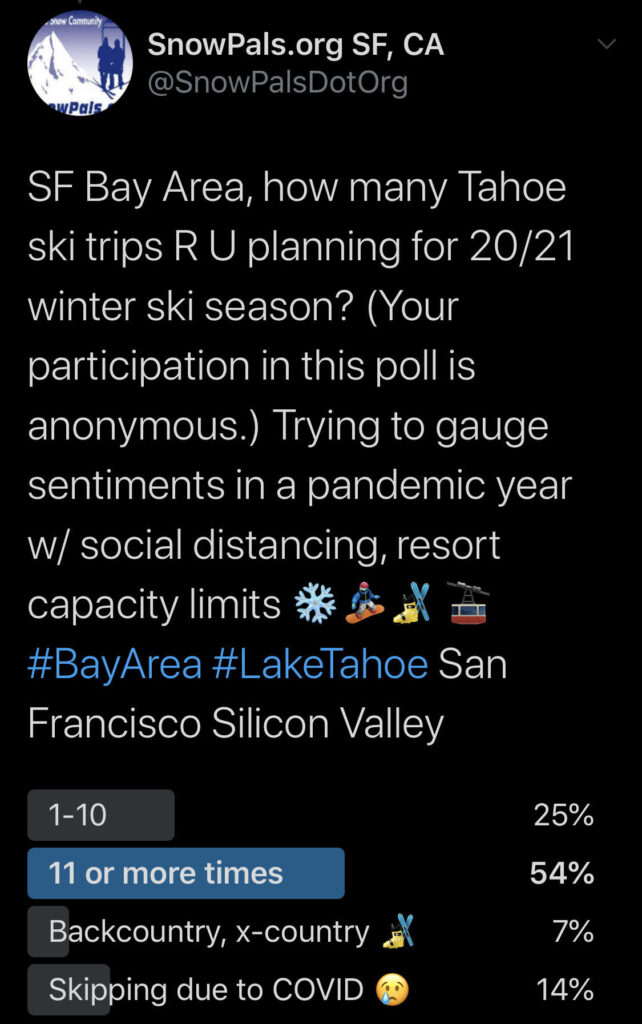
Tahoe winter season poll survey results are in; see how many Bay Area residents plan to sit out 20/21 ski season vs how many people plan to ski, snowboard and how often vs how many people plan to ski, engage in snow-sports in the backcountry?

tahoe-ski-survey

Poll survey result reveals that 14% of people are planning to sit out this ski season due to COVID concerns, 54% plan to take 11+ trips, and 25% 1-10 trips while 7% plan to ski, ride backcountry or participate in other snow-sports.

Season Pass holders’ message is clear: ski, ride as much as possible contingent on Tahoe resorts’ operations staying opened.

Please feel free to with friends and family ♥ 

?❄️☃️⛷?⛸

Looking to share a ski lease or looking for a Tahoe area rental for the winter?

Browse vacation rentals or ski leases.

Good Value Tahoe Niche Property Rental Listing Alternative to VRBO, Airbnb, HomeAway, FlipKey?

http://www.snowpals.org/2020/good-value-alternative-to-vrbo-and-airbnb/

??❄️


Got a ski lease or vacation rental you’d like to list?

List your vacation rental or ski lease.

What will the 2020-21 Tahoe ski season be like during coronavirus/COVID-19?
Read about specific coronavirus safety measures resorts will have in place.


♥ Share this page with friends and family via twitterfacebook.

What Tahoe ski season will be like during coronavirus?

2020-21 Tahoe ski season during Covid-19 coronavirus

As ski resorts open, the most commonly asked question on the minds of many skiers’ and snowboarders’ is:

What will the 2020-21 Tahoe ski season will be like during coronavirus with resorts implementing COVID-19 safety measures?

Tahoe area ski resorts indicated that cleaning and sanitation will increase in frequency and rigor and that physical distancing and masks will be required in indoor areas, base areas, lift mazes, on chairlifts and on shuttle buses.

Only related groups can ride together on chairlifts; there will be occupancy limits at indoor spaces and on shuttle buses, and Ski & Ride School will operate with reduced capacities.

Most resorts will have a reservation system to limit resort and slope-side capacity. Resort visitors will be required to make a reservation before arriving at the mountain. Resorts will limit the number of people allowed on site daily. Many will require you to buy your lift pass and book your time on the slopes at least a day in advance; you can no longer just show up on a powder day and buy lift tickets the day of.

Those with season pass will still need to reserve slope-side days. Resorts will likely sell-out for several days in advance especially on powder days. How does Epic Pass resort reservation system works?

Also as many transactions as possible will be conducted online prior to arrival to reduce interactions.

If you’d like to book your resort visit for fresh POWder days & holiday weekends, the best strategy is to..

Plan ahead by making resort visit reservations if you want to ski on a holiday weekend or whenever there’s new snow in the forecast since resorts are limiting their capacity during the coronavirus pandemic. Check El Dorado (South Tahoe), Placer County (North Tahoe) & your county’s COVID Tier and travel restrictions before you plan your trip. Will you be sharing a ski lease or vacation rental? Tips on how to reduce your risk of COVID coronavirus when sharing accommodations.

Megan Michelson, a reporter with the San Francisco Chronicle, details what Tahoe ski season could look like during coronavirus/COVID-19:

“Winter sports can still happen in the COVID era. Skiing and snowboarding are relatively well suited to a viral outbreak. They take place outside, generally away from others, and skiers are used to wearing face coverings and gloves. But life at ski resorts — assuming they’ll be able to open safely this winter — will not look the same. Many resorts were able to open for limited summer operations, like biking and hiking, and Southern Hemisphere ski resorts in places like Chile and New Zealand opened with strict COVID guidelines. With guidance from public health experts, California ski resorts are now working on reopening plans and how to best protect guests, employees and ski-town communities.

“Things will be different this winter, but we are a highly adaptable industry, having faced droughts, excessive snowfall and road closures,” says Katie Hunter, director of sales and marketing at Sierra-at-Tahoe. “We believe that winter outdoor recreation, when practiced safely, will be a source of healing for people.”

Goggle tans no more
Masks will be required at most ski resorts in congested areas. Vail Resorts — which operates Tahoe’s Heavenly, Northstar and Kirkwood — is requiring face coverings in designated zones, like inside the lodge, in lift lines and in ski school corrals. “Just as other tourist destinations have required, we must ensure that face coverings are not optional if you are walking around with a drink or snack in your hand,” Vail Resorts CEO Rob Katz wrote in an open letter to guests.

Proper masks are preferable to the standard skiers’ Buff. “Synthetic fibers like those in a Buff are technically not as good as a cotton mask, which has more three-dimensional structure to block the potentially virus-laden droplets more efficiently,” says Peter Chin-Hong, a professor of medicine and an infectious disease specialist at UCSF. “But in community mask wearing, fit and convenience trump quality of the mask. For skiers, it’s perfectly fine to use the neck gaiter if it means you will wear it when you need to.”

Give a ski’s length in line
Physical distancing guidelines will also be in place. You’ll find signage and marked spots on the ground to remind you to give at least 6 feet of space while you wait for food, rentals, lifts and other services. You’ll load chairlifts and gondolas only with those in your existing group. (Singles will likely need to ride solo or with empty spaces in between.) Lift lines will inevitably move slower and stretch farther in length.

In the lodge, you’ll find signage that could indicate one-way traffic or specific doors for entering and exiting to eliminate congestion. Yes, everything will take a little longer, but that’s OK. Take a deep breath and be thankful you’re out there.

What day is it anyway?
While everyone used to live by traditional Monday-through-Friday work and school schedules, with schools and jobs going remote, expect to see more crowds midweek and less of a hustle on weekends. With many city dwellers relocating to the mountains with remote jobs, the typical Friday-night traffic flow to Tahoe may be reduced. Best news? If you’ve already relocated to the mountains, your kid can now ski for PE on a Monday and you can squeeze in a midday powder session between Zoom meetings.

Plan your ski days ahead of time
Ticket sales may be capped to limit the number of skiers on the hill each day. Homewood, for example, plans to limit season-pass sales and cap daily lift tickets during peak periods. So this is not the season to spontaneously go skiing. Plan well ahead and purchase lift tickets online and in advance.

“When there are capacity restrictions, you can expect advance registration systems,” says Adrienne Saia Isaac, spokesperson for the National Ski Areas Association. “Ski areas will be responsible for creating clear, up-to-date messaging across their channels, and skiers and riders will need to check the ski area’s website before they hit the slopes to learn about whatever local regulations may be in place.”

Lunch will be served on the tailgate
Ski-town and on-mountain restaurants are pivoting to offer more takeout and outdoor dining options. Think grab-and-go windows, food trucks and patio seating. You’ll still be able to enter lodges and order food, but you’ll find more heat lamps and outdoor firepits to encourage you to dine alfresco. You’ll also see a lot more people packing their own lunch and eating at their car or slopeside condo. In towns like Truckee or South Lake Tahoe, gone are the days of weekend crowds surging popular bars and restaurants. You’ll order food and drinks to go and bring it back to your cabin.

“For skiers, many settings are low risk — particularly those in the open air and while enjoying the slopes,” says Chin-Hong. “One area that is especially at risk is the après-ski setting at the lodge where people may be eating, drinking. I would avoid that area if possible and take your hot chocolate outside or back to your room.”

Goodbye, carpooling
Carpooling to the mountains with people not in your household is a thing of the past, so you may see an uptick in cars heading from the Bay Area to Tahoe. When in the mountains, you can still ride public transportation like buses or on-demand rides to the ski hill, but plan on wearing a mask, sitting far from others and keeping the windows open. Most likely, you’ll be driving your own car or staying close enough to the mountain that you can walk to the lifts. Before you go, check resorts’ apps or websites for up-to-date parking and transportation tips.

Lifties gone robotic
Resorts are moving many services to digital to reduce face-to-face contact. Take Sugar Bowl. The resort has invested in radio-frequency identification scanning gates at all primary chairlifts for this winter, as well as new self-service stations for other services to promote contactless transactions. It’s official: Gone are the days of human ticket checkers scanning your pass in line. This winter, you’ll purchase or reload your lift ticket, sign up for ski lessons and talk to guest services online or via the resort’s app.

You can always cancel
New cancellation policies and beefed-up refund guarantees are now in place to give you peace of mind in case the ski season gets shut down due to COVID or you need to cancel plans for any reason. Vail Resorts introduced Epic Coverage, which comes free with every Epic Pass this season, to provide refunds for certain resort closures, as well as job loss, illness or injury. Ikon Pass — which works at Squaw Valley-Alpine Meadows, Mammoth Mountain and June Mountain — now comes with Adventure Assurance to let you defer use of your pass for any reason to next year.

Sierra-at-Tahoe has a Play it Forward Guarantee that lets you credit this year’s pass to next season due to any unforeseen circumstances, and Homewood’s new guarantee offers prorated refunds on passes if the mountain is forced to close before March 1 due to non-weather events.

Squaw Valley-Alpine Meadows has tentative plans to open on Nov. 25. “Our team is doing everything we need to do to be ready to offer skiing and riding for the upcoming winter season,” says Ron Cohen, president of Squaw Valley-Alpine Meadows. “We are planning for a dynamic environment, building a full set of tools to be able to best respond to whatever comes our way, so that we can continue to offer outdoor recreation to all of our dedicated skiers and riders.” – SF Chronicle.

Looking to join a shared ski lease or are you a ski lease organizer? We’re trying to gauge sentiments, consider sharing your input with the following survey..

Like many of you, the ski/snowboard community is trying to adjust to the new normal with the COVID-19 pandemic still at the top of many of our minds. You can help us by sharing your opinion about ski lease housing options.

Please take a few minutes to help us at SnowPals understand your thoughts for the upcoming 2020/2021 Ski Lease season. Your opinion matters and will help ski Lease operators better adjust. We will publish the top level results for everyone to benefit from.

Access the survey at

https://www.surveymonkey.com/r/RRXDFTP

Advance thanks,

– Your friends at SnowPals

Survey questions created by Mike K., ski lease organizer.


Ski resorts opening dates and operations are contingent on state and local public health restrictions and guidelines during the pandemic; read the latest on COVID-19 pandemic emergency alert to see what businesses are opened:

City of South Lake Tahoe

EL DORADO COUNTY

North Tahoe/Truckee, CA

Placer County Reopening Requirements

FREQUENTLY ASKED QUESTIONS

“The Tahoe-Truckee region is governed by 6 counties, a city, a town, two states, and the federal government. This can create a lot of confusion even when we aren’t operating under COVID-19 restrictions. Here are some frequently asked questions and answers.

Keep in mind, guidelines and laws are changing almost daily; check the latest update at

https://takecaretahoe.org/covid-19/

Every ski area around the world is taking stock as to whether they can operate safely and financially viably this winter in a pandemic. So far the vast majority are deciding yes, but a few have decided “No” – keep track of rolling ski resort updates as they pertain to COIVD-19 restrictions.

♥ Share this page with friends and family via twitterfacebook.

Snowboarding Essential Protective/Safety Gear Checklist

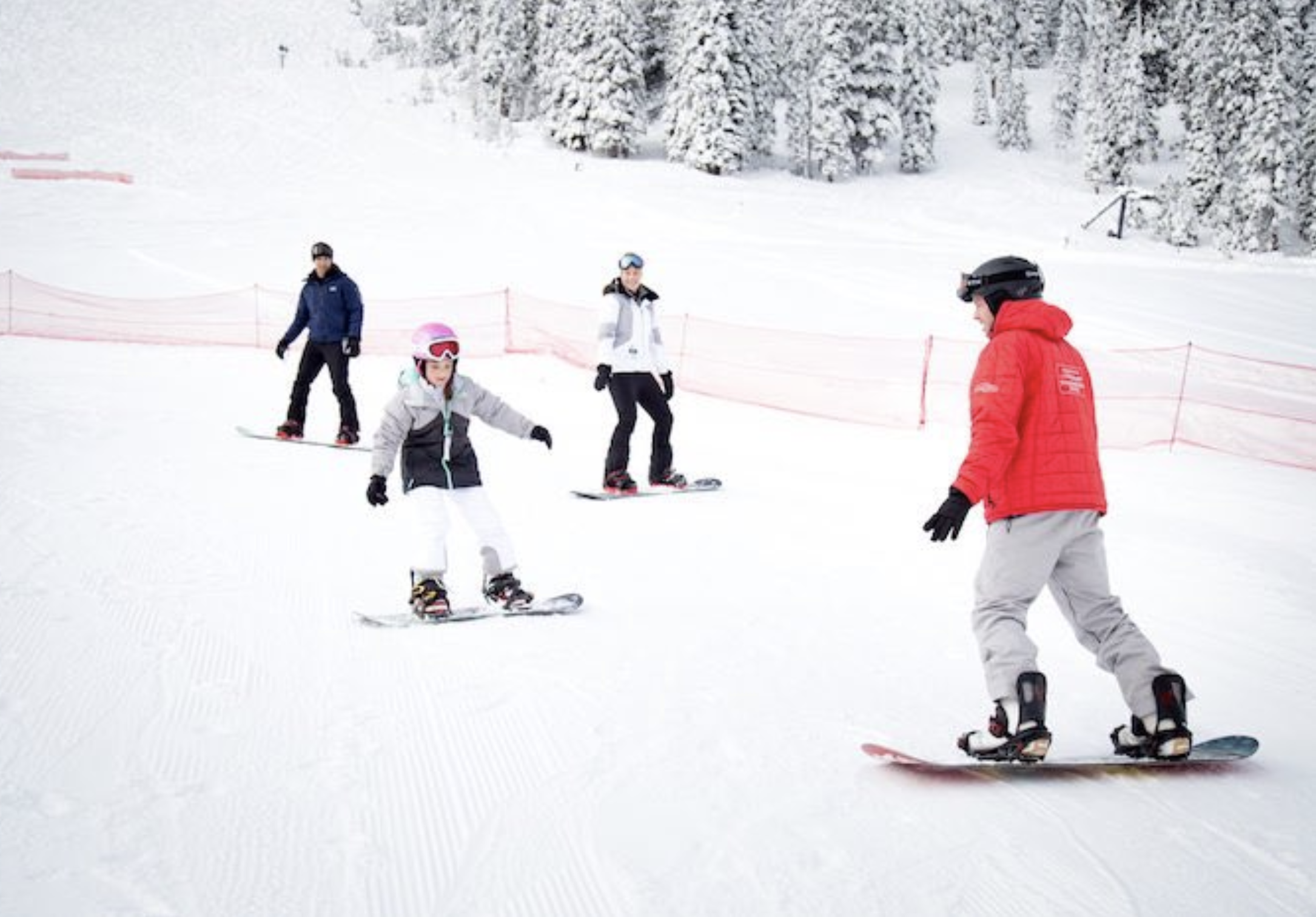
homewood-learn-to-snowboard

Above photo courtesy of Homewood Mountain Resort

A frequently asked question we get from beginner to intermediate snowboarders is..

What are the essential and most effective protective/safety gear available for snowboarding?

When you’re learning to snowboard/ride, you will likely fall in the process of learning the skills required to become competent enough to ride and progress to steeper mountain slopes and terrain.

In addition, for those who would like ride and play in snowboard parks, protective gear will help protect you while doing park features.

For snowboarding, some common snowboarding injuries include knee, chest, elbow, wrist, hips and tail bone.

To protect yourself from snowboarding injuries, the following are ‘must-have’ protective gear since the cost of injury (surgery, medical costs, rehab, pain/suffering, etc) outweigh the cost of buying protective gear; here’s a list of gear you should consider using while learning to snowboard:

(1) Helmet

A helmet is essential to protect your head against injury and concussions. Helmets keep you safe especially when you are learning a new skill or fall/crash when you pick up speed going down the mountain. Always wear a helmet to prevent serious head injuries. Browse sale and clearance deals at REI.

rei-smith-snowboarding-helmet

Above photo: Smith Snowboarding Helmet on Sale at REI

(2) Wrist Guards

For beginners, during a fall, they tend to brace themselves/soften the fall with their hands. Wrist injuries are often problematic since even minor wrist injuries can take at minimum of eight weeks to heal since we use our wrists and hands daily so it’s difficult to heal. A good pair of wrist guards is essential when you’re learning to snowboard. Browse sale and clearance deals at REI.

burton-wrist-guards-sale-rei

Above photo: Burton Wrist Guards on Sale at REI

(3) Pads

Knee pads, elbow pads, hip pads, and butt pads are all designed to help prevent you from injuring yourself especially when you have a hard impact with pact snow and icy surfaces. When learning new tricks in the parks, wearing pads not only protects you but also give you a boost in confidence. Browse sale and clearance deals at REI.

burton-butt-pad-protector-sale-rei

Above photo: Burton Impact Shorts helps protect your hips and butt

Back protectors
Back injuries are not as common for snowboarders, however certain high risk movements in the parks can cause serious injury. However, wearing a back protector will likely restrict your upper-body movement. Browse sale and clearance deals at REI.

(4) Knee Pads
Knee pads can protect you from knee injuries. Try knee pads out to see how they fit, feel and explore the range of movements allowed by the knee pads. Make sure you get the right fit so that the knee pads won’t slide down your leg when you’re snowboarding. Knee pads restrict how much you can flex your knees on jumps, or bend down to get a low turn without feeling a pinch. Browse sale and clearance deals at REI.

burton-knee-pads-sale-rei

Above photo: Burton Snowboarding Knee Pads

When you are learning to ride and/or do park features, it’s wise to use the snowboarding protective gear to help prevent injuries. The protective snowboarding gear not only prevent injuries but also prevents both tangible (costly surgery, meds, etc) and intangible (personal rehab time, pain/suffering) setback. As you progressed and become more skilled, you can opt out of wearing most of the recommended protective gear, however, it’s best to always wear a helmet to protect your head from injuries.

rei-sale-clearance-items

Browse REI Snow Sports sale and clearance items: Alpine, Nordic, Backcountry

What’s the best Tahoe resorts learn to ski, snowboard package deal?
View our list of the best money saving deals; share with family and friends to plan a getaway trip to Tahoe.

♥ Share this page with friends and family via twitterfacebook.

Browse ski leases or vacation rentals. List your ski lease or vacation rental.


Snow-Sports: what safety measures should I take during COVID-19 for myself, family and friends?

Last Updated on January 14, 2021. with family & friends to help keep them safe.

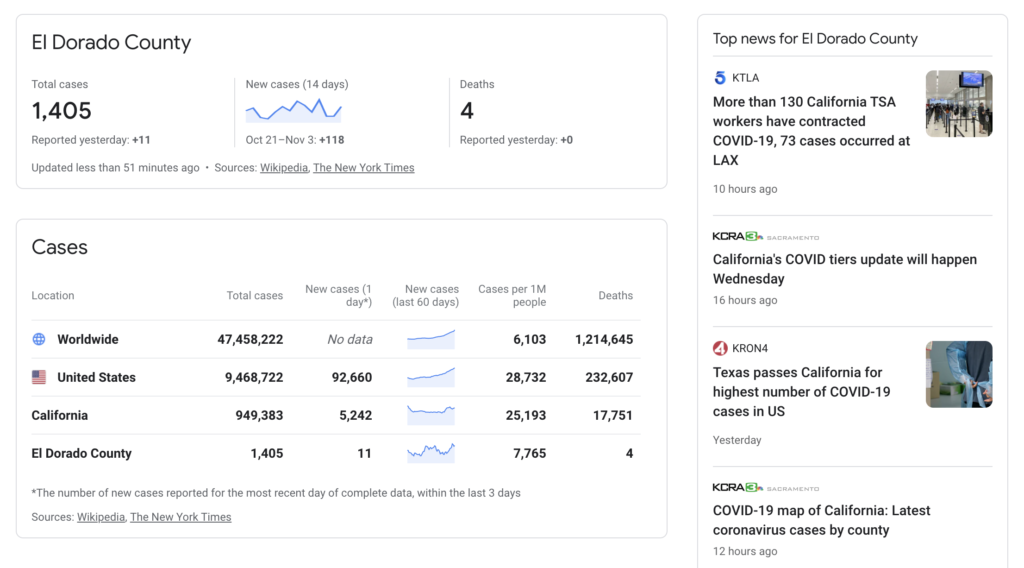
    el-dorado-county-covid

Source: Heavenly and Sierra at Tahoe are resorts located in El Dorado County – https://news.google.com/covid19/map

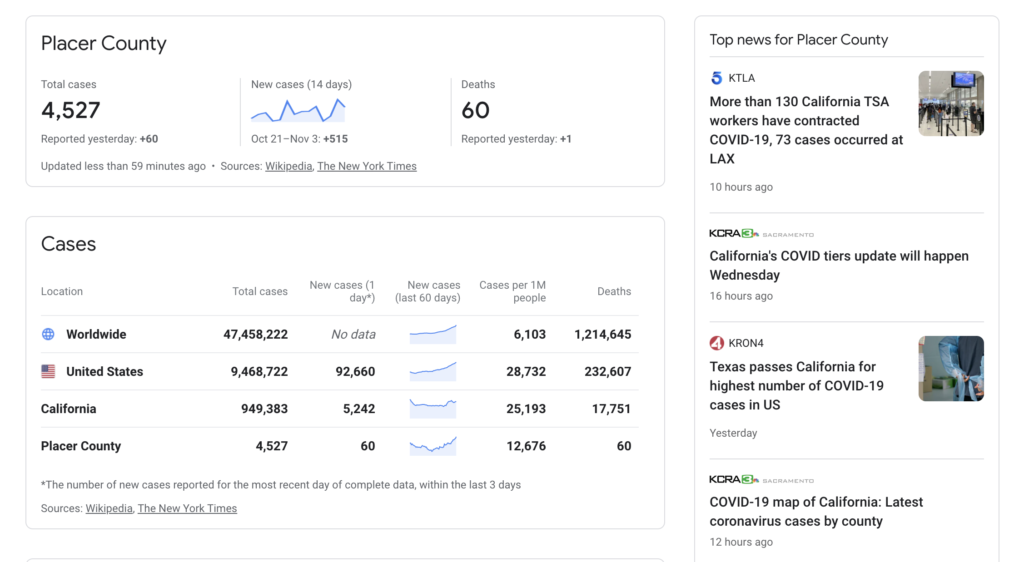
    placer-county-covid

Source: Northstar, Squaw Alpine, Sugar Bowl are resorts located in Placer County – https://news.google.com/covid19/map

Check the current COVID case count for your county and CA’s Covid Tier assignments at

https://news.google.com/covid19/map.

Check El Dorado (South Tahoe).

✔ Placer County (North Tahoe).

*Remember to check your county’s COVID Tier and travel restrictions before you plan your trip. To ski, snowboard at Lake Tahoe resorts, advance reservations are required (no day of lift ticket sales available) because ski resorts have to limit resort’s visitors’ capacity as a Covid mitigation measure.

Still going to the grocery store? With new virus variants spreading, here’s what to do to mitigate your risk level.

View a U.S. Map of COVID-19 cases

https://coronavirus.jhu.edu/us-map

Lodging Share During the Pandemic FREQUENTLY ASKED QUESTION (FAQ)

A frequently asked question SnowPals.org get asked is..

Our group will be sharing a Lake Tahoe rental/ski lease lodge for the winter season and I’d like to ask you what safety measures should I implement during COVID-19 to prevent my friends and family from getting infected with the coronavirus (which will ruin everyone’s enjoyment of snow sports this winter)?

Great question and an important one because although deaths related to Covid19/coronavirus have decreased significantly, however, the rate of infection is still rising quickly as the winter months flu season starts and there is no united or coherent federal leadership and guidance on Covid prevention as states issue various guidance from no masks required to masks mandated.


Before we delve into safety measure tips, let’s first examine the impacts of coronavirus..

Long-term effects of COVID-19

According to the Mayo Clinic, long-term effects of COVID-19 (coronavirus) includes problems with mood swings and fatigue..

Many people who have recovered from SARS have gone on to develop chronic fatigue syndrome, a complex disorder characterized by extreme fatigue that worsens with physical or mental activity, but doesn’t improve with rest. The same may be true for people who have had COVID-19. – Mayo Clinic

Costs for a Hospital Stay for COVID-19

“FAIR Health estimated the costs based on ICD-10 procedure codes and revenue codes associated with flu and pneumonia (lung inflammation caused by infection). We analyzed data from our database of over 30 billion private healthcare claim records, the largest such repository in the country. We found the average charge per COVID-19 patient requiring a hospital stay to be $73,300. That charge is the estimated cost for a patient with no health insurance. It’s also the cost for a patient seeing an out-of-network provider and whose health plan has no out-of-network benefit.

The average estimated in-network amount per privately insured patient is lower: $38,221. The in-network amount is the amount that the providers in the plan’s network have agreed to accept as full payment. It includes both the amount the plan pays and the amount the patient pays. The amount the patient pays is based on the cost-sharing provisions of the plan.

These numbers are useful to know to help you understand how much the COVID-19 pandemic is costing our country. But it’s also important to know that they’re not the actual amount you’re likely to have to pay if you or someone in your family gets COVID-19. If you have insurance, your costs will be determined by the cost-sharing terms of your health plan. If you don’t have insurance, your costs will vary based on your specific case. And you may be able to negotiate a lower amount with your providers.” – https://www.fairhealth.org/article/costs-for-a-hospital-stay-for-covid-19


Symptoms of coronavirus/COVID

COVID-19 affects different people in different ways. Infected people have had a wide range of symptoms reported – from mild symptoms to severe illness.

Symptoms may appear 2-14 days after exposure to the virus. People with these symptoms may have COVID-19:

“COVID-19 is a respiratory condition caused by a coronavirus. Some people are infected but don’t notice any symptoms. Most people will have mild symptoms and get better on their own. But about 1 in 6 will have severe problems, such as trouble breathing. The odds of more serious symptoms are higher if you’re older or have another health condition like diabetes or heart disease.

Here’s what to look for if you think you might have COVID-19.

Common Symptoms

Researchers in China found that the most common symptoms among people who were hospitalized with COVID-19 include:

Fever: 99%
Fatigue:70%
A dry cough: 59%
Loss of appetite: 40%
Body aches: 35%
Shortness of breath: 31%
Mucus or phlegm: 27%

Other symptoms may include:

Sore throat
Headache
Chills, sometimes with shaking
Loss of smell or taste
Congestion or runny nose
Nausea or vomiting
Diarrhea

Look for emergency warning signs for COVID-19. If someone is showing any of these signs, seek emergency medical care immediately:

Trouble breathing
Constant pain or pressure in your chest
Bluish lips or face
Sudden confusion
Inability to wake or stay awake
Bluish lips or face

You need medical care as soon as possible. Call your doctor’s office or hospital before you go in. This will help them prepare to treat you and protect medical staff and other patients.

Strokes have also been reported in some people who have COVID-19. Remember FAST:

Face. Is one side of the person’s face numb or drooping? Is their smile lopsided?
Arms. Is one arm weak or numb? If they try to raise both arms, does one arm sag?
Speech. Can they speak clearly? Ask them to repeat a sentence.
Time. Every minute counts when someone shows signs of a stroke. Call 911 right away.

Lab tests can tell if COVID-19 is what’s causing your symptoms. But the tests can be hard to find, and there’s no treatment if you do have the disease. So you don’t need to get tested if you have no symptoms or only mild ones. Call your doctor or your local health department if you have questions.

Call your medical provider for any other symptoms that are severe or concerning to you.” – WebMD

Is COVID-19 similar to the common cold?

“Coronaviruses usually cause mild to moderate upper-respiratory tract illnesses, like the common cold. However, SARS-CoV-2 can cause serious illness and even death. Why people’s COVID-19 symptoms vary so greatly isn’t fully understood.

What is the difference between the flu and COVID-19 regarding how long it takes to develop symptoms?

Flu
Typically, a person develops symptoms anywhere from 1 to 4 days after infection.

COVID-19
Typically, a person develops symptoms 5 days after being infected, but symptoms can appear as early as 2 days after infection or as late as 14 days after infection, and the time range can vary.

If you suspect you have the above symptoms, take a self-assessment.

The New York Times reported:

The U.S. recorded more than 90,000 new coronavirus cases yesterday, a new daily high. That’s more than one new case every second, The Times’s Mike Baker notes.

Stephanie Ruhle On COVID-19 Diagnosis: I Did All The Right Things, But I Still Got The Virus | MSNBC YouTube Video:

Some good news: Survival rates among severe virus patients are improving. At N.Y.U.’s hospital system, the death rate dropped to 8 percent in August, from 26 percent in March.

COVID-19 VACCINE PROGRESS UPDATE

READ the latest news on the progress of an effective COVID-19 vaccine (link opens in new window to show vaccine news update)

Coronavirus vaccines 101: What you need to know

What is a vaccine?

How will vaccines for the new coronavirus work?

Are these vaccines safe?

If a vaccine is working, how soon will a person who gets it be protected?

Why bother with a vaccine if we can just slow-burn until herd immunity?

Why do I keep hearing people talk about vaccines that are “safe and effective?”

How soon will coronavirus vaccines be ready?

How soon could I get a vaccine?

What’s a clinical trial? And what are these trial “phases” anyway?

Who will get vaccines first?

Will coronavirus vaccines have side effects?

UC HEALTH answers the above questions in a clear and easy to understand explanation 😉 – https://www.uchealth.org

Preventative Safety Measures

To prevent Covid infection/transmission, aside from keeping social distancing, our recommendations are sourced from leading career doctors and scientists:

(1) Agree on a set of safety protocols but most importantly, all members of the ski lease must stick to following them without fail. As a group collectively agree to and implement ‘preventive health measures like frequent hand washing, physical distancing, and wearing a mask when going out in public, to help protect themselves and to reduce the chances of spreading the infection to others.’ – Read Harvard Health’s Recommendations

Have available at all corners of the ski cabin/ski lease from ski lodge entrances to bedrooms, hand sanitizer bottles readily available to use in all community areas/located by high touch shared items, microwave, door knobs, etc.

Work collectively means it’s critical to keep everyone in the loop and to communicate clearly with daily updates especially if a member have recently been in high risk situations/exposed to Covid. Make use of Group Coordination and Collaboration Calendars and Tools to keep everyone in the loop.


(2) Use HEPA air purifiers – one for each bedroom, one for the living, dining room area which can remove up to 99.97% of bacteria, molds, and viruses. ‘And long enough exposure to the UV light in an air purifying device can disable some viruses, including COVID-19.’ – https://www.mdanderson.org.

Find an AHAM (Association of Home Appliance Manufacturers) Certified Room Air Cleaner. Performance is key when choosing the right air filter for your home. – https://ahamverifide.org/directory-of-air-cleaners/

(3) Buy and use the best available N95 masks, CDC approved, NIOSH certified N95 masks

(4) Check your central air/heating system to see how air is directed/identify air flow vents and see how air is directed into each room of your home. If your air vent is blowing air from mid-torso to head level, consider having a qualified handyman or AC/Heating specialists install air flow duct accessories that will direct the outbound air directly to the ground. Why? It has been shown that air flow directly to the ground is key in preventing virus transmission by directing the air to the ground instead of to the torso and head level where infected asymptomatic person(s) virus exhalation can be captured and spread by the air flow of the AC/Heating unit.

See screen-capture photo of how airflow on an airplane effectively does this:

    heating-unit-air-flow-covid

Effective use of HEPA certified air purifiers to eliminate coronavirus:

    hepa-filters-covid

Safe travels start with science

“Studies show COVID-19 exposure risk is minimal when air filtration systems and masks are in use
The latest research is showing that aircraft cabins are among the safest of public indoor environments. According to a recent study conducted by the U.S. Department of Defense (DOD), the risk of COVID-19 exposure on board our planes is almost zero thanks to advanced air filtration systems, required mask-wearing and diligent cleaning protocols.

Since airlines began putting these measures in place in spring 2020, “there has been little evidence to date of onboard disease transmission,” according to researchers at Harvard T.H. Chan School of Public Health. Their report notes that when the “highly effective” ventilation systems are running from boarding until deplaning, which is our practice at United, the risk of exposure falls below that of activities like grocery shopping and dining out.

And even when the plane is full, on average only 0.003% of infected air particles could enter the breathing zone of seated, masked passengers, according to the DOD study.”

Reference:

Read Harvard’s study
Read U.S. Department of Defense’s study

How using a humidifier to maintain your house’s humidity at 40-60% is optimal in reducing the risk of viral infections in the common flu and Coronavirus infections:


How taking Vitamin D supplements during the winter months help to boost your immune response to viral infections including Covid-19?

YouTube Interview with Professor Roger Seheult, MD; Dr. Seheilt explains the important role Vitamin D may have in the prevention and treatment of COVID-19. Dr. Seheult illustrates how Vitamin D works, summarizes the best available data and clinical trials on vitamin D, and discusses vitamin D dosage recommendations.

Roger Seheult, MD is the co-founder and lead professor at https://www.medcram.com

He is an Associate Professor at the University of California, Riverside School of Medicine and Assistant Prof. at Loma Linda University School of Medicine

Dr. Seheult is Quadruple Board Certified: Internal Medicine, Pulmonary Disease, Critical Care, and Sleep Medicine


How maintaining regular exercise helps to boost your body’s immune system?


How effective are masks in terms of preventing Covid infection/transmission?

Mask Standards and Effectiveness Bottom Line


– Single use masks (normally one layer, very thin) are typically only effective at capturing larger dust particles, but can do so fairly well.

– Surgical mask standards have higher requirements for capturing virus-sized (0.1 micron) particles, however they vary by region.

– Pollution masks (respirators) typically capture >90% of virus-sized particles. You can use the rating system in the table above to see the exact proportion each certification requires. This includes ratings such as N95, KN95, FFP1, FFP2 and FFP3. – https://smartairfilters.com/en/blog/comparison-mask-standards-rating-effectiveness/

n95-masks

COVID-19: Droplet or Airborne Transmission? Penn Medicine Epidemiologists Issue Guidance

CDC updates guidance on aerosolized COVID-19 spread


Where do you buy your N95 NIOSH certified masks?

https://www.idcband.com/en-us/respirator-face-masks/

* Disclosure: SnowPals.org does not get any kick-backs/commission for any of the links in this featured article btw.

Comparison of Mask Standards, Ratings, and Filtration Effectivenesshttps://smartairfilters.com

(5) Collectively agree to get Covid tested 24-48 hours of first meetup at the ski lease cabin(in the meantime, shelter in place until you get your test result); share test results prior to first meetup, after which all ski lease members keep a contact journal of daily activities and share any incidents of concern. Keeping a social contact and activities journal can be time consuming but if it means everyone in the ski lease is more mindful of his/her contacts and activities they engage in that can be cause for concern/considered high risk, can then be shared among all members. Communication is key. Find free Covid testing near you (opens in a new window using Google search).

Which ski lease group did the most research and analysis on best practices for Covid safety protocols?

http://www.snowpals.org/leases/covid-adjusted-south-lake-tahoe-ski-lease-share/

Feel free to contact Mike (the ski lease organizer – see contact link in above URL) to share tips.

Additional Reading

Tahoe Ski Season Survey & Insights
Read about specific coronavirus safety measures Tahoe resorts are implementing to keep staff and visitors safe


CNN TRAVEL COVERS skiing in times of COVID..

the ‘lodge’
Flexibility is key
Ticket to ride
Planning for the worst

https://www.cnn.com/travel/article/skiing-seasons-changes-coronavirus
?

✔ Keep track of United States vs California’s COVID19 cases as winter flu season starts.

Johns Hopkins Coronavirus Resource Center: Homecoronavirus.jhu.edu

Johns Hopkins experts in global public health, infectious disease, and emergency preparedness have been at the forefront of the international response to COVID-19 pandemic.

Who’s going to pay for Covid-19 treatment?

FDA’s information on the effective use of UV Lights and Lamps: Ultraviolet-C Radiation, Disinfection of Coronavirus

✔ Estimating potential spending on COVID-19 care, a report by Brookings Institute www.brookings.edu

What is the trend for snow sports during these times?
What did New Zealand do to control COVID-19 to successfully get to zero new infection; how did they managed to keep it that way, and what we can learn from them?

Please feel free to with friends and family ♥ to keep them safe 😉

?❄️☃️⛷?⛸

Engage in Critical Thinking

– Critical to democracy & survival of citizens of these United States of America

TOTALLY UNDER CONTROL – Official Documentary Trailer On-demand on Hulu

On Demand October 13
On Hulu October 20

On January 20th, 2020 the US and South Korea both discovered their first cases of COVID-19. However, 9 months later, the novel Coronavirus has claimed the lives of over 200,000 Americans and caused staggering economic damage, while in South Korea, there were no significant lockdowns and, in an urbanized population of 51 million, only 344 lives have been lost. Where did we go wrong? As the presidential election nears, Americans are increasingly enraged by a lack of clear leadership, endemic political corruption and left to wonder how did the wealthiest and most powerful country in the world manage to fail so thoroughly in its response to a global pandemic?

Academy Award-winning filmmaker Alex Gibney, directing with Ophelia Harutyunyan and Suzanne Hillinger, interrogates this question and its devastating implications in Totally Under Control. With damning testimony from public health officials and hard investigative reporting, Gibney exposes a system-wide collapse caused by a profound dereliction of Presidential leadership.

It will be a generation before we know the full extent of the damage wrought by this pandemic, but Totally Under Control will stand as the definitive account of the Trump administration’s incompetence, corruption and denial in the face of this global pandemic.


Survival Guide & Tips: Skiing with Kids

skiing-with-kids-tahoe

By Joe Woo, Snowpals’ Resident Ski Gear Tester & Columnist. 

Skiing with kids. It seems like a simple thing. But let me tell you. If you haven’t done it before and aren’t prepared for it, it can ruin a great time on the slopes. However, with the right preparation, it can be more fun skiing with them than skiing without them. For those of you toying with the idea of finally bringing the kids up or maybe you’re considering bringing up a nephew or niece…read this. What I’ll do first is share some of my kid skiing experience and what we do to make it lots of fun.

For me, skiing pre-kids was easy. I never thought about anyone else. I never considered having to ski with anyone. If anyone I was skiing with slowed me down or was having a bad time, I could separate from them and meet up with them later. That was no big deal. When you add kids to the mix, things really change. The main thing is that you can’t just dump the kids and continue skiing when they’re cramping your style. When you’re on the mountain with your kids, you’re stuck with them for better or for worse. What is a parent to do?

Over the last two seasons I’ve come up with a pretty good system for skiing with kids. My wife and I came up with it using trial and error to finally dial in something that works for our family. It was a lot of effort using trial and error and lots of frustration but it was worth it. Why go through all the effort? Why not just dump the kids in ski school for the day so that I could ski without them?

Cost is an obvious issue, but more importantly skiing with my kids is fun. It is more fun than skiing without them because when they’re having fun, there is nothing better than skiing together, laughing together and watching them learn, grow and overcome all the little challenges of skiing. The look on their face when they accomplish something they didn’t think they could is priceless and worth more than anything in the world. When it is good, skiing with them is better than any skiing I could do on my own.

So, what’s the issue? Those fun times were rare and didn’t happen often. When they did happen, they were priceless, however it seemed like the bad times outweighed the good times. Finding a way to make those fun times happen more was something I had to do.

So, how do you do that? What I discovered through two years of trial and error is CCSF. What does this mean? Confidence, Comfort, and Sated (not hungry) equals Fun. If you can get the Confidence, Comfort and Sate (not hungry) issues right that will equal Fun for your family. Lets look closer at each element.

Confidence

Confidence is a very important thing for anyone. It is especially important for kids to have when skiing. I’ll go so far as to say that confidence is so important that I believe it is the foundation to successful family skiing. Without confidence, the kids will never want to ski, will dread skiing and will make your time on the mountain miserable. You should do everything in your power to build your kids confidence in skiing.

How do you do that? For us we decided to always try and put our kids in skiing situations that we knew they could be successful. We never made them do anything we knew they would fail at. They quickly built confidence the second day they ever skied. The thing that built confidence the most was succeeding in tasks when they were scared of doing something even though I knew they could do it. These were the cases where I pushed them hard because I knew they could do it, but they needed to realize they could do it and when they did it you could see the confidence grow.

For example, my 5 year old son refused to ski without being between my legs and me holding him down the bunny slope. I knew he would crash at first if he tried skiing by himself as this was his first time on skis. After about 5 runs between my legs I started to stop actively holding him and he would ski holding me. Then after a few runs of doing that we would stop halfway down the hill, put his skis in pizza and let him go so that he was standing still on the hill in pizza. Then I would go about 10 feet in front of him and tell him to slide to me. At first it was a struggle because he didn’t want me to let go of him. He would cry when I would let go. I just wanted him to slide to me in pizza. He didn’t have to stop. I would catch him. But he was scared to do it, but I knew he could do it and he finally did through the cries and tears. Once he realized he had actually done it, he did it again.

At first it was 10 feet, then 20 feet and I would stop him. If he veered off course I would slide over to catch him. Then I told him to stop by himself and he just did it. He was amazed that he could stop by himself and the rest is history. He skied the rest of the day by himself without ever turning. Just pizza strait down the hill with his arms held in front of him like he was ready to do some serious karate chops. His way to balance I guess. The next day he was turning back and fourth and excited about skiing.

My daughter was the same progression at the same time. Soon they got bored of the slope and asked to do another lift. We moved onto another beginner lift with slightly steeper terrain and a longer run. That was last year at Diamond Peak. They gained so much confidence at Diamond Peak, Mt. Rose and Squaw Valley. I continued to teach them parallel skiing and my daughter is no longer in pizza. My son is in an advanced pizza today, but is almost ready for parallel skiing.

Today my younger son is six and my daughter is eight and both are happily skiing black diamonds off Red Dog, KT-22, Headwall and other lifts at Squaw Valley. My older son is actually skiing (as opposed to just surviving down) West Face, Tower 16 and the various terrains off Silverado chair! It is amazing what a little confidence can do. My kids are testament to that without ever having professional ski lessons. Whatever you do, make sure the kids gain lots of confidence. I truly believe it is the foundation to successful family skiing.

Comfort

Now your kids are confident skiers. Is that it? Not really. No matter how confident they are, if they are not comfortable, they will complain and ruin your day. Kids are not mature enough to overcome the little issues so they don’t ruin the big things like a fun day of skiing. Our kids are pretty tough and the last thing we do is baby them, but every kid has a limit to what comfort they’re willing to give up on to have fun on the slopes.

It is important that you take the time to learn what your kids comfort limits are and make sure those needs are satisfied. My kids don’t complain that much about their comfort. I think it is because I’ve invested in making sure they stay warm and dry no matter the conditions. They have top of the line ski pants, jackets, gloves, base and mid layers. They have great helmets and goggles. Goggles were an issue and I finally got them decent stuff that doesn’t fog and they can clean easily. Another important piece of equipment was the neck gator. It seals out the cold air getting in from the neck. The kids rarely complain about being cold or wet and it is one less issue we have to worry about.

Sate

Kids don’t do well when they’re hungry. Instead you sould make it a priority to make sure they’re sated and not hungry. This one is really simple. Kids start getting moody and melting down when they get hungry. It is amazing. They are like Dr. Jekyll and Mr. Hyde. Feed your kids periodically and your chances are better at having a great day. We discovered that if we have a big breakfast, lunch around 12:30 or 1, 2:30 heavy snack and small snacks on the lifts in between, we avoid the hunger meltdown altogether. Now I always have a large Hershey bar in my pocket and on every other lift ride, I’ll give each kid one piece to eat. This system has worked great this season.

Skiing with your kids can be fun and very rewarding. Just remember that kids have unique needs that you have to consider. The best way I know is to remember CCSF. Confidence, Comfort and Sated equals Fun. Try is next time you’re out with the kids. Good luck!

=====

More skiing with kids tips for parents..

From Jeremy Feinberg, a Ski Instructor at Kirkwood for 6 years plus, a certified PSIA Level 2 instructor, training for Level 3; he teaches skill levels that range from first timers to expert; he coaches a Progression team that skis 99% of the legal terrain at Kirkwood.

As someone who makes their living teaching children how to ski I can say that there are some good things in this survival guide; a comfortable and well fed child is one who is set up for success, and depending on the child, confidence can be a limiting factor, however in the 1+ page of text there was very little emphasis on skill development and no mention at all of the physical and cognitive limitations that change as a child grows.

That being said, a few things to keep in mind include: 

It’s hard to learn new skills when people are on terrain that is at the edge of their comfort level, dial it back, gain ownership over the movements and then take it to the steeper snow.

Confidence can be a good thing, but you can have too much of a good thing… your child needs to ski in control and not be a menace or hazard.

Leash and harness systems enable parents to get younger kids on the snow but can reinforce bad habits, however the harnesses themselves can be useful for picking up kids from the snow and helping them on to the lift.

The Edgy Wedgie can be a useful teaching tool, try it for a run or two, take if off and see if the child can stop without it… use it for a few runs, not a few days or seasons.  

If its your child’s first time skiing, start on a small hill below the lift, 30-50 feet long and almost flat with a flat runout at the bottom, or a gradual uphill if you can find it, learn to stop there, then head to the chair.

Some children perform at a higher level with their parents around, some excel within their peer group under the tutelage of an experienced coach, it helps to know which group your child falls into

The pace of skill development as detailed in the Survival Guide sounds about right, just keep in mind that today I had a 6 year old girl first time skier (along with a five year old girl with separation anxiety issues whose mother checked her out after lunch) who was able to stop within the first hour, we were on the chairlift before lunch and making turns.  By the time her parents picked her up (1/2 hour early) she had taken several runs through the trees. Tomorrow after a brief warm up she will be ready for the lower intermediate lift.  Her older brother who was on a snowboard was unwilling to follow us through the woods.    Her parents were impressed by her success and gave me a generous tip.

If you want to get your child out of the wedge and making turns that have a least some parallel at the end of each turn, and you want that to happen quickly, ski school is the place for your child, especially on the weekdays when group sizes are small and only experienced and highly certified instructors are getting any work.  

Please don’t be that person who has their child skiing advanced terrain in a power wedge, if you are going to ski with your child and teach them how to ski, make the day about them, you need to be there to support them and help them along the way.  

Recognize the limitations of your own teaching abilities and don’t let your child (or yourself) get stuck in the skill rut; if you have any questions about how this can manifest one can use the intermediate rut as an example: go to most ski resorts and watch the way people on the intermediate runs ski, particularly how they initiate their turns.  What you will see in most cases are varying degrees of stem (wedge or pizza) to start the turn.  People make this movement because they are not comfortable performing a movement that ski instructors call crossover.

Crossover is the movement that separates advanced skiers from people that ski advanced terrain, it is defined my crossing your center of mass over your skis, down the hill into the new turn (basically throwing one’s body down the hill, swooping your skis underneath the body to catch the center of mass)  

Crossover one example of a movement that can define a skill rut, it’s difficult to teach and limits a person’s ability to explore and enjoy the mountain.

**On a related note** Teaching the spouse or significant other how to ski is tough, I call it the relationship tester, put that person in a group or private lesson, meet up for lunch and ski together in the afternoon, at their pace, where the instructor said would be a good place to ski.  Your romantic relationship is one of equals, the student/teacher relationship is not, things can get ugly quick.

♥ Share this with friends and family via email, twitterfacebook.


Benefits of a ski lease

benefits of joining a ski lease

Benefits of a ski lease:

  • You have your own Tahoe vacation home for the entire ski season.
  • Convenience of being able to leave all personal belongings and ski gear instead of packing and repacking for every trip.
  • Peace of mind knowing you have a place to stay for weekends and holidays when hotel rates are expensive. Having a ski lease saves you (1) money over the long term and (2) the hassle of booking hotel and lodging during popular periods such as holidays.
  • A great perk with the ability to invite guests and entertain in your own ski lease home.
  • Save money by being able to BBQ or cook your own meals.
  • Sleep in your own bed and have the ability to do laundry.

Do you have a season pass or plan to buy one? Would you like to put your season pass to maximum use by logging as many days as you can? Consider joining a ski lease for lodging convenience and save money over the long run.

Let’s say the average ski lease membership costs about $1,200 for five months, from Dec. 1 to April 30. Let’s say you ski/ride for three weekends a month(or 6 days a month) or a total of 30 days for the season; the cost would break down to $40 per day. That’s inexpensive(a great value) compared to weekend hotel rates in Lake Tahoe which typically cost $80 or more on the weekends and significantly more expensive on holiday weekends. It’s easy to find out whether joining a ski lease is viable or not by figuring out how many total days you plan to ski/ride over the entire season; using that number to divide by the cost of joining the ski lease which will give you a per day cost.

In addition, becoming a member of a ski lease is a great way to expand your social circle, meet people to ski/ride with, share transportation expenses to Tahoe and make new friends.

Read our ski lease guide for some useful tips and advice on organizing a ski lease.

Looking to join a Tahoe ski lease for 2012-13 season? View available ski leases at:

http://www.snowpals.org/leases

Ski leases are as low as $750 and up depending on duration, location and how many members. If you are looking for members to join your ski lease, list it on Snowpals to get it in front of thousands of SF Bay Area skiers and boarders for referrals! Check out our ski lease listing and our vacation rentals listing.

♥ Share this page with friends and family via email, twitterfacebook.

New to Snowpals? Sign up for Tahoe rideshare, mixers, get advice, interact with members by joining the group.

Are you a property owner looking to lease your place?

Read up on our tips for drafting effective ski lease agreements.

Which Tahoe resort do you ski / ride at most often?

View Results

Loading ... Loading ...

Tahoe weekend getaway: colorful Autumn drives & events

alpine county fall color lake tahoe fall colors

When’s the best time to see the color of fall foliage around Tahoe?

You don’t have to live on the East Coast to enjoy Autumn’s foliage colors. Plan a Tahoe weekend getaway to feast your eyes on the fiesta of fall color happening from the end of September through October when the color changes are most dramatic. Mid-October is usually at the peak of fall foliage for a temperate fall season where the change in temperature is gradual and when the weather pattern eases into winter. If, however, there is a sudden cold front or an early snow, fall leaves can depart the trees practically overnight. 2012 fall season is looking to be mild so far as of September 19, 2012.

Around Lake Tahoe, aspens are the main trees displaying the mountains with a mix of gold and orange. Other trees changing foliage colors: big leaf maple (the first to change, between 3,000 and 4,000 feet in elevation is dressed in bright yellow) dogwood (5,000′, dogwood are pink and green), and black oak(tinged with orange leaves).

Scenic Lake Tahoe drives & points of interest:

  • Drive up the Mt. Rose Scenic Byway
  • Drive around Lake Tahoe south on Highway 28 on the Nevada side
  • Spooner Lake is a good scenic place for an easy walk through the trees around the lake.
  • Marlette Lake offers excellent intermediate hiking; providing several miles of golden aspens.
  • Drive on US 50, from Zephyr Cove to Stateline and South Lake Tahoe, fall color cascades from the mountain slopes down to Lake Tahoe shores.
  • Hope Valley, south of Lake Tahoe, is one of the best vibrant aspen color showing around. Hope Valley draws photographers galore seeking to capture the essence fall color display.
  • If you’d like to be at the center of it all, immerse yourself in the vibrant colors of fall by visiting the city of Markleeville(also known as the Alpine County seat). Plan a weekend getaway to go hiking, biking, camping and enjoy a relaxing soak in the hot spring pool at Grove Hot Springs State Park. Make your plans soon because the colors of Autumn might be here today and gone tomorrow. Before you know it, snowflakes will be fluttering to earth blanketing landscapes white.
Tahoe’s Autumn Notable Events:
  • Oktoberfest at the Village at Squaw Valley on Saturday, Sept. 29, 2012 starting at 11:00 am (enjoy Bratwurst,  excellent German beers, free entertainment & live music).
  • The 3rd Annual Lake Tahoe Restaurant Week, October 7-14, 2012, gives foodies an opportunity to enjoy 3-course, prix-fixe menus for lunches and dinners at 25+ participating restaurants throughout the Lake Tahoe region for $20, $30 or $40 per person. “The Tahoe Restaurant Week is a celebration of the scrumptious cuisine and culinary talent that has made the Lake Tahoe region the best mountain dining destination in the country. Delight your palate with menus that incorporate organic, seasonal and local ingredients – all served up at Lake Tahoe’s charming and historic eateries and bistros.”  – View a list of participating Tahoe Restaurants.

Tips:

  1. Call hotels in the area you’d like to visit and inquire to see if Autumn foliage colors are at their peak before making a visit.
  2. Keep tabs on California locations with the most dramatic fall color changes by visiting California Fall Color.


Tahoe Ski Resorts are Hiring!

Looking for a job? Why not work and play at your favorite ski resort?

October and November are job fair months. Tahoe Ski Resorts are Hiring for the 2012-13 ski season! Applicants are encouraged to apply online, at the job fair or in person. Here’s a  summary on who’s hiring; visit your resort of interest for more information on job openings and how to apply. Good luck! 🙂

Lake Tahoe Ski Resort Jobs

1. North Lake Tahoe

  • Alpine Meadows & Squaw Valley USA –

    Get a job this winter at Squaw Valley or Alpine Meadows! Working at Squaw and Alpine offers you the opportunity to mix fun and recreation, make lifetime friendships, garner personal achievements and get valuable work experience. The Job Fair will be held in Olympic House at Squaw Valley. Applicants must apply online prior to the Job Fair, which is by invitation only. Walk-ins will be permitted, but not guaranteed an interview. Job Fair Date: 11/03 – 10:00am to 6:00pm at Olympic House, Squaw Valley. Phone: 530-452-7112

    Learn about the open positions and apply online  |  Benefits of working at Squaw/Alpine

  • Boreal – BOREAL JOB FAIR

    OCTOBER 20, 2012 ~ 10 AM – 2PM @ BOREAL MOUNTAIN RESORT

    Take the opportunity to meet with Boreal managers in person.  Interview for one or several winter positions available for the 2012/2013 ski season.  The job fair will take place in the Boreal cafeteria from 10 am – 2pm on October 22, 2011 with interviews on a first-come first-serve basis.  Apply online today and you could potentially have a job line-up prior to the job fair.

  • Diamond Peak
  • Homewood
  • Mt. Rose
  • Northstar-at-Tahoe (part of Vail Resorts)
  • Sugar Bowl – Job Fair – October 20th

    Mark your calendars for our on-site Job Fair on Saturday October 20th from 8am – 3pm at the Mt Judah Day Lodge. You will have an opportunity to meet with managers from all different departments and interview for the position that best suits you!

    We provide a welcoming escape from everyday life that brings family and friends together, creating memories of all-mountain adventures. Come join the Sugar Bowl team. It’s Your Turn…

    Working at Sugar Bowl has its advantages:

    • Free Unrestricted Season Pass
    • Season Passes for dependents of full-time employees
    • Flexible schedules
    • Half off food
    • Rental and retail discounts
    • Discounted childcare for children 4 to 6 (Mon – Fri, non-holiday)
    • Complimentary lift tickets for friends and family
    • A variety of employee activities

2. South Lake Tahoe

  • Heavenly Mountain Resort (part of Vail Resorts) – 2012/2013 Heavenly Resort Job Fair at the California LodgeSaturday, October 20, 9:00 am – 2:00 pm
    You must apply online prior to attending the job fair at  www.jobs.vailresorts.com

    HEAVENLY SEASONAL AND YEAR-ROUND EMPLOYMENT

    Have you ever wondered what it is like to ski or ride in fresh powder thousands of feet above one of the most pristine alpine lakes in the world? Do you like meeting new people from all over the world? How about sunshine? Would you like to live, work and play in a state that averages over 300 days of sunshine per year?

    Well if you answered yes to any of these questions, then welcome to Heavenly, Lake Tahoe’s premier winter playground! Jaw-dropping views of Lake Tahoe, combined with enthusiastic and dependable employees, makes Heavenly one of the greatest places to work in the world. Our guests consistently rank Heavenly as having some of the most helpful, friendly, knowledgeable, and customer-oriented employees in the resort industry.

    Here at Heavenly the only thing deeper than our snow is our commitment to our guests and your work experience, so come join us this winter and help make our ski resort a destination like no other. Please take time to explore our employment website and see what Heavenly has to offer!

    And did we mention the location? Well South Lake is located only 180 miles (290 km) east of San Francisco, 140 miles (225 km) north of Yosemite National Park and 60 miles (95 km) west of Reno.

  • Kirkwood (part of Vail Resorts) – 2012/13 Kirkwood Job Fair Saturday, October 13 from 9:00am – 3:00pm at the Red Cliffs Building at Kirkwood Mountain ResortBe sure to complete an online application by clicking here prior to attending a job fair.Have you ever wondered what it is like to ski or ride in fresh powder on your lunch break?  Do you like meeting new people from all over the world?  How about sunshine?  Would you like to live, work and play in a state that averages over 300 days of sunshine per year?Well if you answered yes to any of these questions, then welcome to Kirkwood, the Sierra Nevada’s premier winter playground!  Jaw-dropping views, combined with enthusiastic and dependable employees, makes Kirkwood one of the greatest places to work in the world.Here at Kirkwood the only thing deeper than our snow is our commitment to our guests and your work experience, so come join us this winter and help make our ski resort a destination like no other. Please take time to explore our employment website and see what Kirkwood has to offer!
  • Sierra-at-Tahoe – If you are interested in any of our winter positions for the 2012/13 season, please complete an online application and plan on attending our Hiring Fair on Saturday, November 3, 2012. Department Supervisors will be on site conducting interviews in the Main Lodge from 9am – 2pm.


Tire chains installation instructions: The Easy Way

Every season I see the same people struggling with chains. Since most vehicles are now at least front-wheel drive, it’s easy!!!! Install your own tire chains with this easy guide or let the pros do it and pay $30.00!

Applies to ladder style chains (cable or link).

The following is not the instructions provided by chain manufacturers, but I know from years of experience that the following is the best method for front wheel drive or when using the front wheel as the chained wheels on all-wheel or 4 – wheel drive.

Park car on level ground.

Turn steering wheel to full left lock

Drapes chains OVER the left front tire such that the ends of the chains, at the back of the tire, just touch the pavement. If you have chains with adjustable straps, you want the NON-STRAP end, to be touching the pavement at the back of the tire.

Get in the car and prepare to go in reverse. Grasp the steering to prevent the steering wheel from self-straightening as you back up. Back up a very small amount (1/4th to 1/3rd of a revolution of car tires.) Since you are holding the steering wheel steady, the vehicle should describe a shallow “c” shape as you go back. DON’T LET THE FRONT WHEELS SELF-STRAIGHTEN!

Shift into park.

Get out and you will notice that because the tire on the driver side is “winged out”. It is easy to reach to the inside of the tire to grasp the ends of the chains and affix the connection device. YOU MUST AFFIX the inside first. Then affix the outside connection device. Do the driver’s side first so as to get a sense of how far the vehicle must move to affect a ¼th to 1/3rd tire rotation. You can see this when doing the left side, but not the right (passenger) side.

Turn the steering wheel to full right lock and repeat the entire procedure for the right front tire.

After both chains are installed, drive the vehicle back and forth in a straight line a few feet and then re-tighten them to get the cable chains to encircle the tire more tightly.

If you hear the chains slap against the inside of the wheel wells after they have been tightly adjusted as you drive, use rubber bungee cords or rubber chain tighteners, etc. to increase the tightness of the fit. ~ ">Ron